Wednesday, October 12, 2011

James Jirat Patradoon

As a huge comic book nerd, I've bumbled my way through dozens of colorful narratives, most of the time nitpicking through all the oversized breasts and made up muscle groups that make comics so great. It is not often, however, that I am stunned by this kind of art--I mean, you can only go so far with your art without detracting from the plot (ask Frank Miller), so you could say comic book art is limited. For this reason, I find the comic-book like stylings of James Jirat to be a delightfully funky fresh punch in the face. His colors are aweful and awesome, and who doesn't love hooded luchador wrestler bikers popping pills and punching out super heros? While many of his themes are a throw-back to the amazing punk poster artists of the late 70's and 80's, the tasteful use of punch-out color and bitmap-style line renderings make it all work together somehow. His art is on display out Californie-way this month, so if you're out there, dig on some of this.



All of these works belong to James Jirat Patradoon, and can be found with more of his work at:
www.jiratpatradoon.com 

Tuesday, October 4, 2011

Alfons Mucha

Little needs to be said about the tightly controlled, whimsical work of Art Nouveau artsist, Alfons Mucha. His beautiful females have probably graced more puzzles, t-shirts, and black light posters than Bob Marley, and his work never ceases to amaze. Few artists have the intricate mastery of line and color that together make Mucha's work so stunning, and his smooth shading techniques would make a digitial artist envious. Mucha's work is now mostly over 100 years old, however, with his work's emphasis on advertising, it makes you wonder where the "Ad men" went wrong, and how things like "wuu-u-u-uh-zu-u-u-u-uhhh" and that stupid gecko manage to sell anything. One drawback that I've noticed only after researching Mucha's work is the prevalence of horrible Mucha tattoos out there. Take a gander toward google images, and you'll see what I mean. While Mucha's work captures a moment in stunning lines and color, its intricacy and detail doesn't lend itself to good tattoo material without covering, say, your entire back, or...without adaptation by a very good tattoo artist. Moral of the story--tattoo artists are called artists for a reason--if you hand them an image and they say it can't be done, it probably shouldn't be.


Tuesday, September 20, 2011

Willem de Kooning

So artists and art critics have been drooling over abstract expressionist Willem deKooning's work for the better half of the last century, and for good reason. The guy painted for over 70 years, and produced a huge body of diverse work, including paintings, drawings, and some particularly lumpy sculptures. But, most of what can be said about his work has already been addressed, either in hours of boring modern art lectures, or in the pompous overwrought musings of internet art nerds (myself not included...ha..ha..) Today, however, I'm not going to talk about his now oh-so-overdone style of action painting, or what his nudes have to say about the condition of women, or how he redefined art through a child-like perspective. What I find interesting about de Kooning's work is much more basic, and to all you aspiring artists out there, much more utilitarian--Color. As many comic book colorists, painters, and graphic designers will attest, figuring out which colors work well together to create a unified image that is pleasing to the eye is no easy task. There have been entire classes and textbooks written on the topic of color theory, and even then, knowing what color to paint a black cat is in the dark, or what the reflection of television light does to the color of fabric can seem almost impossible. De Kooning's work, however, shows a beautiful innate understanding of light and color, to the point where the nature and subjects of his abstractions are rendered inconsequential. Few artists can use color alone to impress mood or atmosphere upon a piece, but de Kooning delivers every time-- invoking feelings of claustrophobia, leisurely ease, or untold femininity without having to beat you over the head with a graphical representation. This alone makes de Kooning's works stand out in the world of abstract art, and makes each of his pieces an interesting study for those that wish to follow in his colorist wake.


All of these images are property of the Willem deKooning estate.
Currently, de Kooning's work is on display at the Museum of Modern Art (MOMA)
in New York. For more images, and how to go see them, check out their website:
http://www.moma.org

Monday, August 29, 2011

Walter Potter

As we move further into the 21st century, it becomes obvious that as a culture, we are at a loss as to how to deal with mortality, to the point where we'd rather hide that fact behind the beauty of innovation, surgery, and media than face it as the only definite truth to our humanity. A hundred years ago, one winter could wipe out one's entire family, and the idea of death was a local, personal idea that was not shied away from. Our move away from this can be seen in the near extinction of funerals held at home, the antagonization of people who kill animals for food, and more interestingly, the demise of the taxidermist. If you have some country cousins, you may have encoutnered the eternally-bored disembodied deer head, or in my family's case--the striking rattlesnake under the glass coffee table, perfectly preserved for whatever reason. While I've previously showcased some modern taxidermy art by Sarina Brewer, recently I was introduced to the grandfather of modern taxidermy art, English artist, Walter Potter. He made most of his morbidly cute little assemblages at the height of the Victorian era when people would put these weird things under glass domes in their sitting rooms (no shit), and they really speak for themselves. If you can get over where this guy got his hundreds of dead kittens, guinea pigs, owls, frogs, and squirrels, each piece is weirdly whimsical and interesting, and incredibly detailed.


Monday, August 22, 2011

Deborah Butterfield

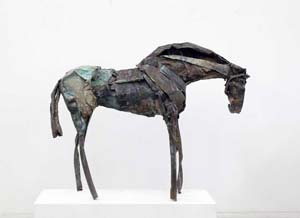
There's nothing that can express the duality of domestication like the horse. They are powerful, spirited, amazing animals capable of incredible feats of majesty and unrestrained force and beauty. At the same time, most of their species exists in the humble service of man, willing to run and work until their backs are broken, or they collapse in death from the struggle against the reigns. This makes the mercurial works of Deborah Butterfield so magical. With each piece, made from metal castings of driftwood and scrap, she encapsulates so many different facets of the life of horses, from their most powerful to their most mundane. Each piece has a life all its own, and a personality that is befitting of its title, which instead of giving glory to the artist, are mostly names that breath life into the memory of these amazing beasts.