Showing posts with label apocalyptic rococo. Show all posts

Sunday, January 20, 2013

Andreas Franke

Deep in the waters off the coast of Barbados there lies a merchant vessel lost to fire long ago, the SS Stavronikita. Permanently enshrined as a scaffold for a coral reef, the ship has become a haven for all matter of undersea life since its demise. The result is an intricate web of lifeforms clinging to and moving about the silent ship, muting the hard man-made edges of the structure while adorning it with the most interesting of shapes and textures. It is some of these values (as well as some existential bullshit about the obvious "life finds a way" metaphor that permeates these kinds of landscapes) that initially drew the attention of photographer (and photo manipulator) Andreas Franke, in his "The Sinking World" series. Juxtapositions of the sunken ship with period costumes may seem like something out of a Celine Dion music video circa 1997, but the images are fresh, and the subject matter flippant. Rococo (the style of his costumed models) glorified an aesthetic of excess--Can you put any more gold leaf on that? Then do it. Cover everything else in and mink and lace? Done. The result is a ballooning of textures and decadence that works as a nice focal point for the silent, grave-like silhouettes of the dead ship, also decadently adorned by festive corals. While too much of this kind of kind of art can descend into pure kitsch, these, and the rest Franke's work are definitely worth the browse.


Check these and more out at Franke's website: The Sinking World

Thursday, June 30, 2011

John Martin

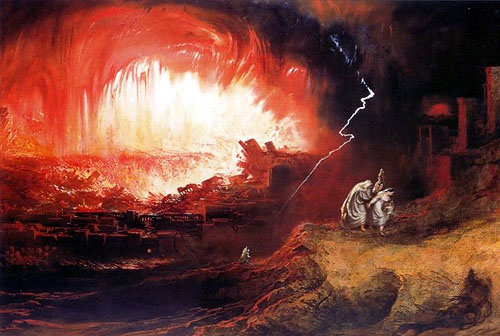
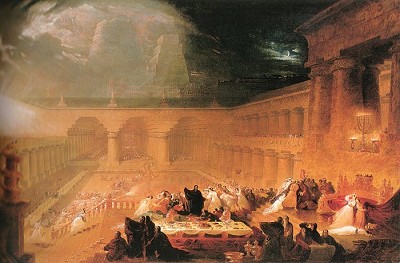
So, let's face it, the bible can be boring. For every action-packed  pillar of fire and brimstone episode, there's a couple hundred pages of what fabrics not to wear and whose dad was whose. Luckily for us, most of the cool stuff in the bible can be summed up in the works of Christian painter, John Martin. Martin lived during early 1800s, and was actively involved in the romanticism art movement, for all you Art 101 kids searching google images the night before your paper is due. It's okay, I won't tell anyone. Anyway, Martin's work is amazing in the depth and breadth of his landscapes, which are all pretty much apocalyptic. There are no sugary sweet fat Jesus babies being cradled by doe-eyed virgins in these works. Each piece shows the fiery wrath of God in full color, from mountains crashing down, exploding volcanoes, storms, floods, falling angels, you name it. And they are breath-taking. The thunderous crag-like clouds are ominous and foreboding, and you can really get the atmosphere he was going for. When they were made, the paintings were immensely popular, however, at the peak of his popularity, Martin gave up painting to pursue some other wacky enlightened endeavors, like redesigning the London sewage and water systems, railroads, and light houses. He was also considered sort of an odd-ball-- preferring to hiss during the national anthem, for instance. Though his paintings themselves are amazing, his body of work has continued as a major influence to numerous artists today, notably George Lucas, H.P. Lovecraft, and Derek Riggs, that guy that paints the covers for Iron Maiden.


Thursday, February 3, 2011

Apocalyptic Hedonism: Kris Kuksi

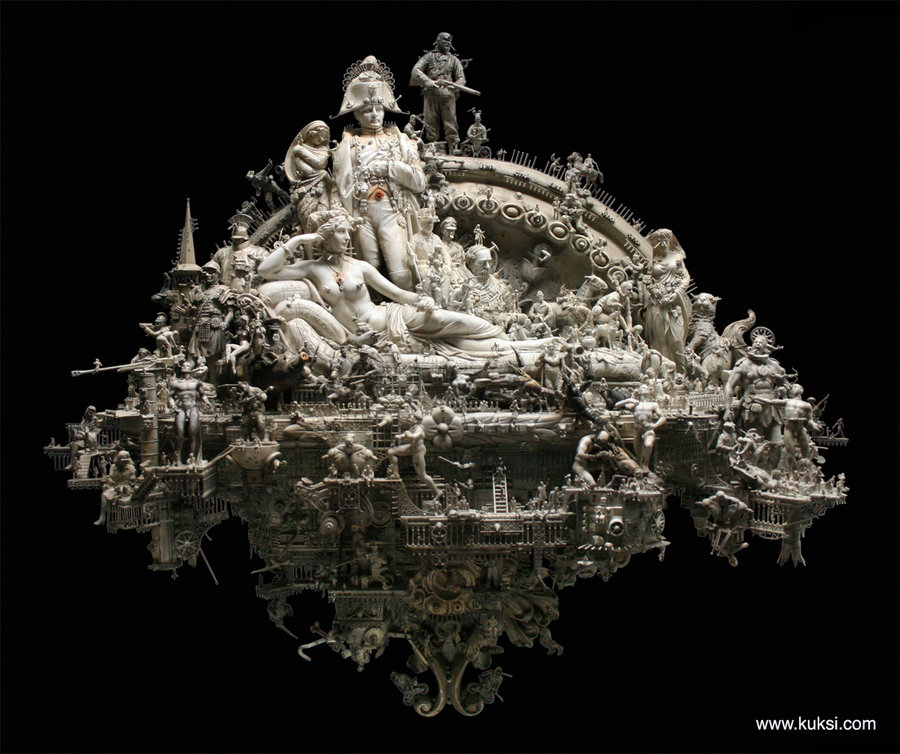
”When falls the Coliseum, Rome shall fall; And when Rome falls – the world”.   This quote by Lord Byron begins the web biography of Kris Kuksi, sculptor, genius, and general madman. His sculptural pieces, self-described as post-industrial rococo, are as beautiful as they are unsettling. While death and destruction make up much of the subject matter in Kuksi's pieces, the soft touch of a Rococo aesthetic is as welcomed as it is well-placed.The assemblages of smaller, infinitely detailed figurines and mechanical wonders add a claustrophobic intensity to the subject matter surrounding the end of the world. Each piece teeters on the edge between subtle beauty and hopeless destruction, war and unfettered hedonism, tyranny, life, and death. I've tried to include some close-ups in order to fully realize the intricacy of these works, which really can only be fully enjoyed in person, but you can see what I mean:


Close up: 


Check out more work and different angles and close ups of these works at